Evolved, Yet Stuck on “It’s Just Human Nature”
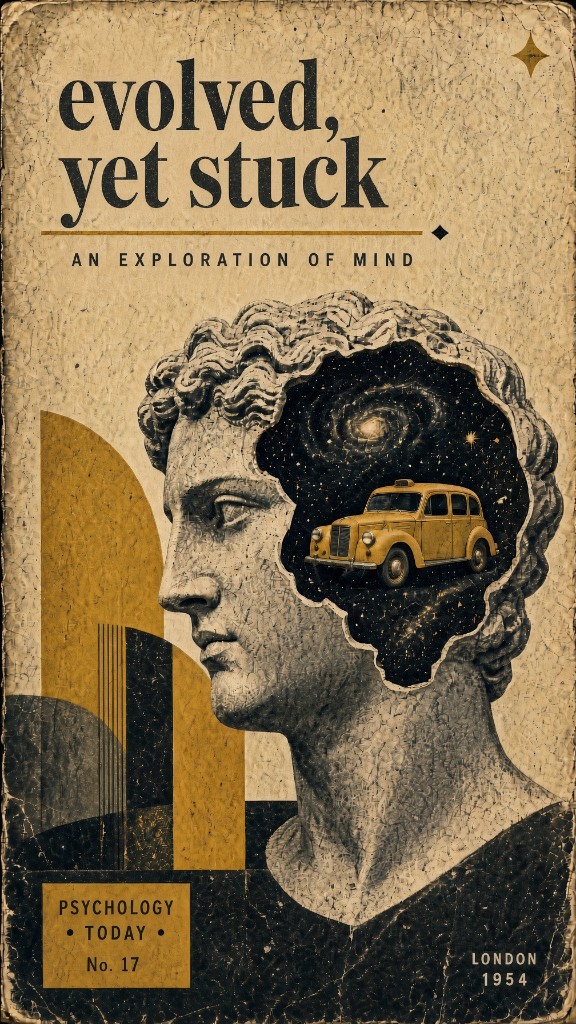
We spend most of our lives ignoring our biological limits. We fly across oceans, drink oat milk, work on laptops, and fix bad eyesight with lasers. Yet the second someone wants to defend an exhausting social habit or a broken system, they suddenly start talking like a museum tour guide: “Well, what can you do? That’s just human nature.”
I’ve been thinking lately about why that phrase works so well. Mostly, I think blaming our DNA is just a great way to get out of doing chores. If a bad behavior is baked into our caveman brains, nobody has to feel bad about it, and nobody is responsible for fixing it.
I’m not a scientist, so I went looking into what the research actually says about where our behaviors come from. It turns out the science is full of blind spots, old arguments, and unsettled questions.
For decades, behavioral scientists accidentally studied the weirdest kids in class and assumed they spoke for the whole school. In a 2010 paper titled “The weirdest people in the world?”, Joseph Henrich, Steven Heine, and Ara Norenzayan pointed out that most psychology studies rely on people from Western, Educated, Industrialized, Rich, and Democratic societies. Usually, that just means American college students doing surveys for extra credit. When researchers actually bothered to test people in other parts of the world, a lot of supposedly universal human instincts varied wildly, from how we judge fairness to how we see optical illusions.
Henrich’s 2016 book The Secret of Our Success and Kevin Laland’s Darwin’s Unfinished Symphony (2017) take this further. They argue that cultural inventions like cooking and toolmaking actually steered our genetic evolution over thousands of years. Biologists still argue over how far that feedback loop goes, so it isn't settled law. Still, it points to an awkward problem: a lot of what we call “human nature” is really just modern Western culture looking in a mirror.
Even when scientists look at deep evolutionary history, they have a bad habit of making up stories that sound good after two beers. Back in 1979, evolutionary biologists Stephen Jay Gould and Richard Lewontin wrote a paper (“The Spandrels of San Marco and the Panglossian Paradigm”) criticizing colleagues who assume every human quirk exists because it helped our ancestors survive on the savanna. Anyone can sit in an armchair and invent a tidy reason why being greedy or tribal must have been a smart prehistoric survival strategy. Proving it with hard evidence, rather than just shrugging and saying “makes sense to me,” is much harder.
We fall for these stories because we are deeply attached to whatever is already happening. In 1988, William Samuelson and Richard Zeckhauser coined the term “status quo bias” after finding that people heavily prefer whatever option is set as the default. Worse, as John Jost, Mahzarin Banaji, and Brian Nosek showed in “A Decade of System Justification Theory” (2004), people are often motivated to defend and rationalize the existing social order, even when that system directly hurts them. Calling the status quo “human nature” is the easiest way on earth to keep the default settings.
Plenty of things we assume are built in turn out to be recent inventions or learned habits once you look at the history.
Marrying for love is a good example. If you watch reality TV, you’d assume soulmates are an ancient biological rule. Yet in Marriage, a History (2005), historian Stephanie Coontz shows that basing marriage on romantic love only caught on in the West around the 18th century. For thousands of years before that, marriage was a practical deal between families to secure land, in-laws, or livestock. Love was a nice bonus if it happened, and a headache if it got in the way of a good goat trade.
Reading is another one. In Reading in the Brain (2009), neuroscientist Stanislas Dehaene explains that writing was only invented a few thousand years ago, which is way too recent for us to have evolved a dedicated reading center in the brain. Instead, learning to read is basically a bootleg operation. We repurpose older brain wiring originally built for spotting physical objects and animal tracks, and train it to decode tiny squiggles on a page.
Even our physical brain structure shifts with experience. A 2000 study by Eleanor Maguire and her colleagues looked at London taxi drivers who spent years memorizing “The Knowledge,” a mental map of 25,000 streets and thousands of landmarks. Compared to regular people, the cabbies had a larger back half of their hippocampus (the part of the brain used for navigation), and the longer they drove a cab, the bigger that area got, though the front part was smaller. That study is a comparison rather than proof of cause and effect, and it shows real trade-offs, but it still points to an adult brain that changes shape based on how we use it.
Meanwhile, some of our favorite beliefs about how the brain is wired don't hold up at all. Many of us were told in school that we are “visual learners” or “auditory learners.” Yet a 2008 review by Harold Pashler and colleagues (“Learning Styles: Concepts and Evidence”) looked at the data and found no solid evidence that matching teaching to a student’s supposed learning style actually helps them learn. It was just a neat idea that everyone accepted as obvious.
None of this means we are born as empty vessels. In The Blank Slate (2002), psychologist Steven Pinker makes a serious case that biology and evolved predispositions really do shape human behavior alongside culture. We aren't infinitely flexible. It's also worth being skeptical of newer biological claims that sound exciting, like the popular idea that trauma gets passed down to our kids through epigenetics. A 2014 review in Cell by Edith Heard and Robert Martienssen noted that while plants pass down epigenetic changes all the time, whether it happens in humans to any real degree is still unclear.
So when someone leans back at dinner and says “that's just how people are,” treat it as a claim that needs proof, not a settled fact. Biology matters, and evolution is real, but “human nature” gets used way too often as a cover story for things we’re just too tired or too comfortable to change. When someone blames a modern problem on the Stone Age, it's worth asking what evidence they actually have, and who stays comfortable if we all buy the story.
Christina